Mechanism without dose is marketing, and dose without a timeline is impatience. This page gives both: what each nutrient on the Gelagen panel actually does, and how fast the tissue it targets can possibly respond.
The direct answer
Biotin and the B-complex feed keratin synthesis; folate and B12 support the cell division behind skin renewal; vitamins A, C and E with zinc act as an antioxidant group; pantothenic acid supports barrier lipids. All real mechanisms at published amounts — and all limited by how fast skin, hair and nails can physically grow.
First, how skin, hair and nails actually renew
All three are keratinised tissues that renew continuously, and all three are slow. The epidermis turns over roughly every 28 days in a healthy adult, though that lengthens with age. Fingernails grow about 3 mm a month, toenails about half that. Scalp hair grows about 1 cm a month, and each follicle cycles through growth, transition and resting phases lasting years.
This is the single most important fact about any supplement in this category, and it is the one most often skipped. No nutrient can make a tissue grow faster than its own cycle. Whatever Gelagen contributes, it becomes visible only in tissue grown after you started taking it — which is why a fair assessment runs eight to twelve weeks and why nails, being measurable, are the honest place to look first.
The nutrient chain inside Gelagen
Step 1. Two gummies deliver thirteen published nutrients
Biotin 5,000 mcg, B12 6 mcg, B6 2 mg, folate 442 mcg DFE, pantothenic acid 5.2 mg, vitamin A 630 mcg, vitamin C 20 mg, vitamin D 10 mcg, vitamin E 7.4 mg, zinc 2.7 mg, iodine 42 mcg, choline 0.04 mg and inositol 40 mcg — plus 10 calories and 3 g of sugar.
Step 2. Biotin and the B-complex feed keratin synthesis
Biotin is a cofactor for carboxylase enzymes involved in fatty acid and amino acid metabolism, which is where keratin building blocks come from. This is the mechanism behind the hair and nail claims.
Step 3. Folate and B12 support cell division
Both are required for DNA synthesis. Skin is a continuously renewing tissue, turning over roughly every 28 days in a healthy adult, so the nutrients supporting cell division are genuinely relevant to it.
Step 4. Vitamins A, C and E plus zinc act as an antioxidant group
Vitamin E protects membrane lipids, vitamin C works in the water phase and regenerates vitamin E, vitamin A regulates keratinocyte differentiation, and zinc is a cofactor for superoxide dismutase. The group logic is sound.
Step 5. Pantothenic acid supports the barrier
As the precursor to coenzyme A, it feeds synthesis of the lipids that make up the skin's moisture barrier. This is the honest version of the hydration claim.
Step 6. Then the timeline does the rest
Skin turns over roughly every 28 days, fingernails grow about 3 mm a month, and scalp hair about 1 cm a month. Nothing nutritional shows up faster than the tissue can grow, which is why an eight-to-twelve-week assessment is the minimum honest one.
See the current Gelagen sale pricing
Bundle pricing on the Gelagen official website falls from $79 to $49 a bottle. Three and six ship free within the US with six bonus guides.
View Gelagen PricingOfficial website checkout · 60-day guarantee · confirm the terms before paying
Where the mechanisms are strongest
Vitamin A has the most direct relationship with skin of anything on this panel. It regulates keratinocyte differentiation, and it is the nutrient behind the entire retinoid class in dermatology. At 630 mcg, 70% of the Daily Value, it is a real contribution — and the competing page never mentions it.
Zinc has the clearest deficiency signature: a well-described skin eruption, poor wound healing, hair loss. It is a cofactor for hundreds of enzymes including superoxide dismutase. At 25% of the Daily Value it is a top-up, in a well-absorbed citrate form.
Pantothenic acid at 104% feeds coenzyme A, which the body uses to build the lipids of the skin barrier. This is the honest version of the "deep hydration" claim, and it does not require hyaluronic acid to be true.
Where they are weakest
Vitamin C at 20 mg is 22% of a day's requirement. Vitamin C is an essential cofactor for the enzymes that build collagen, which makes it the most relevant nutrient to the collagen story — and a single orange supplies more than this serving does.
Choline at 0.04 mg and inositol at 40 mcg are present in amounts that cannot do anything. The label itself prints choline as 0% of the Daily Value. Inositol studies use two to four grams; this is 40 micrograms. Both are ingredient-list entries rather than doses.
Why the timeline has to be 8 to 12 weeks
Because of the growth rates above. In eight weeks a fingernail has grown about 6 mm — enough to see a change in the new growth if there is one. In twelve weeks scalp hair has grown about 3 cm. Skin has turned over roughly three times. Anything shorter is measuring the tissue you already had.
Which produces the timing problem at the centre of this purchase: the guarantee runs 60 days, a twelve-week assessment is 84 days, and the two do not overlap. Diarise your refund decision for day 50.
What would make it work better
- Wear sunscreen daily. For skin ageing it is the single most evidence-based intervention there is, and nothing in a bottle replaces it.
- Get blood tests if something changed suddenly. Thyroid function, ferritin and vitamin D explain a great deal of hair and nail trouble, and all three are treatable.
- Eat enough protein. Keratin is protein; nutrient cofactors cannot compensate for missing raw material.
- Take it consistently and photograph your starting point in the same light.
See the numbers on the Gelagen ingredients page, or read what Gelagen is for the wider context.
Questions people ask about this
How long does Gelagen take to work?
Plan on 8 to 12 weeks. Skin turns over roughly every 28 days, fingernails grow about 3 mm a month and scalp hair about 1 cm a month, so nothing nutritional can show up faster than the tissue grows.
Should Gelagen be taken with food?
The label says two gummies about 30 minutes before your morning or afternoon meal, with a full glass of water. Several of the nutrients here are fat-soluble, so taking them near a meal is sensible.
Does Gelagen boost collagen production?
There is no collagen on the panel. Vitamin C, which the body requires as a cofactor to build its own collagen, is present at 20 mg — 22% of the Daily Value, less than a single orange.
What should I measure to tell if it works?
Nails are the most objective option: mark the growth line with a pen and watch it move, and note whether new growth splits less than old growth did. Photograph skin in consistent lighting on day one and at weeks four, eight and twelve.
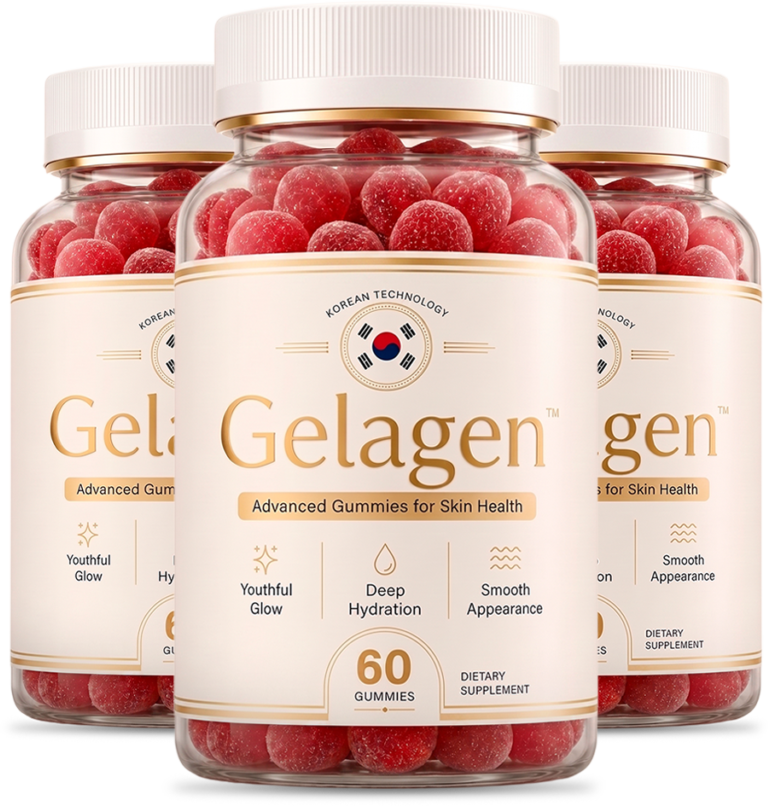
Gelagen Official Website
per bottle on the 6-bottle pack · free US shipping on 3 and 6
Check Current Price 60-day guarantee · official checkout only